
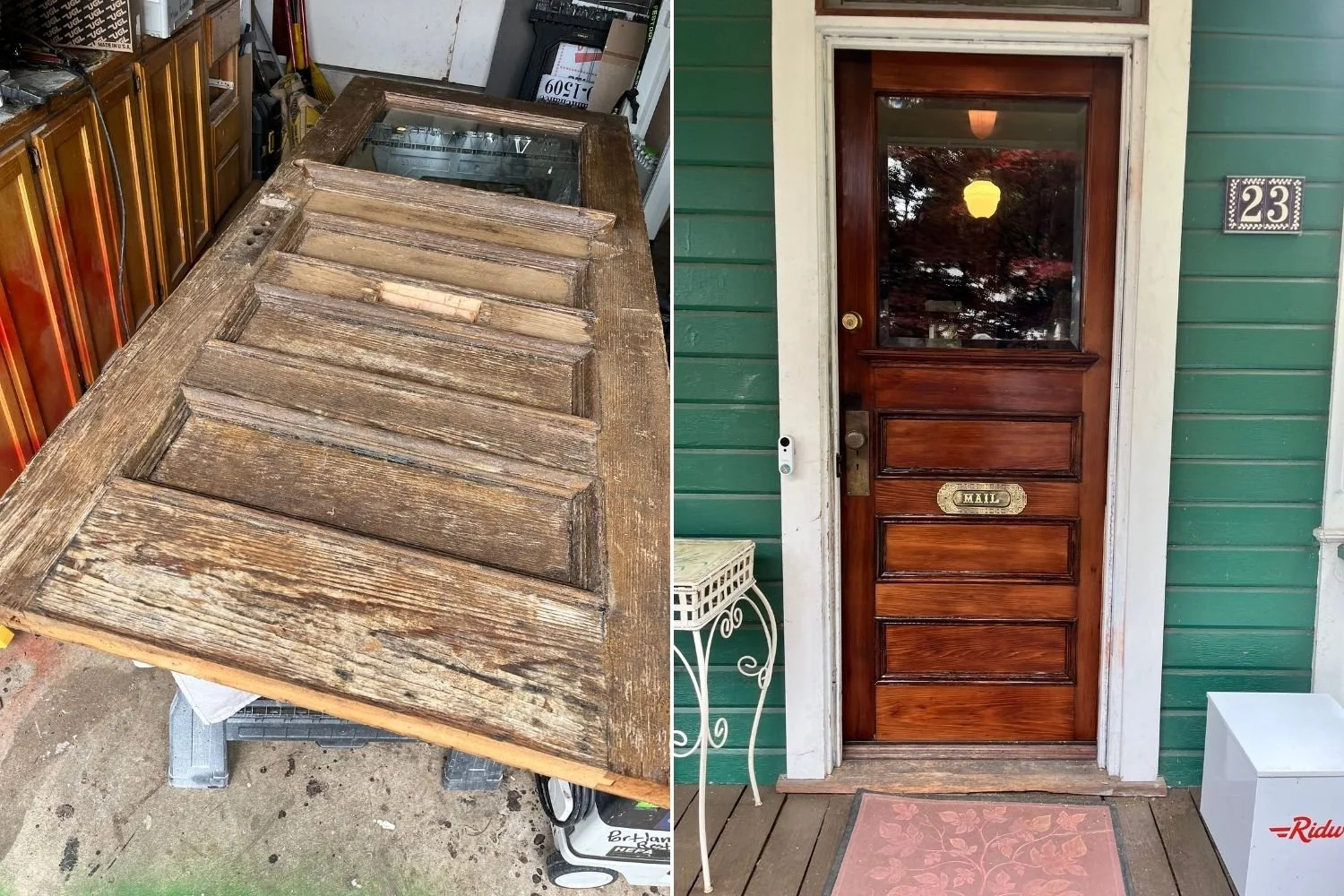
If you live in an older Portland home, you’ve probably looked at your front door at some point and wondered whether it still has life in it. Maybe the finish is faded and chalky, the wood looks gray under the peeling stain, or the door has started sticking every time it rains. Maybe you’ve noticed some soft spots near the bottom rail and you’re not sure what to do.
The good news: a solid wood door is almost always worth saving. The craftsmanship in an original 1910 Portland entry door is generally better than what you’ll find in a new big-box replacement — and restoring it usually costs less than replacing it, too.
The tricky part is knowing which path your door actually needs. Wood door restoration in Portland usually comes down to one of three options: a full refinish, targeted repair work, or outright replacement. This guide walks through the decision the way we’d walk through it with a homeowner in person — what each path involves, what door refinishing and repair typically costs in the Portland area, and the honest signs that point you toward one option over another.
Why Portland Homes Are Hard on Wood Doors
Portland’s climate is tough on exterior wood in a pretty specific way. We don’t get the baking UV of Phoenix or the brutal freeze-thaw of the Midwest, but we do get nine months of moisture followed by three months of intense western sun. That cycle is what beats up finishes: the wood swells when it rains, contracts when it dries, and every time it moves the clear coat on top cracks just a little. Once the finish cracks, water works its way into the end grain — usually at the bottom of the door — and rot starts from the inside out.
On top of the weather, most of Portland’s housing stock was built before 1940. Homes in SE, NE, and N Portland frequently have original fir, cedar, or oak doors that have been refinished two, three, or four times over the last century. That’s actually a good thing — those doors were built to be maintained — but it means by the time you’re calling a contractor, there’s usually more than one thing going on. A door that “just needs a refinish” often also has a loose joint, a sagging hinge, or a small bit of rot that should be addressed while the finish is off anyway.
The Three-Way Decision: Refinish, Repair, or Replace
Before you call anyone, it helps to know which general category your door falls into. Here’s the quick version:
| Condition | What it usually means |
|---|---|
| Faded, peeling, or grayed finish — wood underneath is still solid | Refinish |
| Finish problems plus sticking, loose panels, small rot spots, or failed weatherstripping | Repair (usually combined with refinish) |
| Structural rot through the door, warping, split rails or stiles, or the door no longer seals | Replace — but match the original style |
In our experience, probably 70% of Portland decks we get called to look at are in the first two categories — they need real repair work, not a rebuild. Full tear-downs are the less-common call.
Not sure where your deck falls? A quick in-person look usually settles it in about 20 minutes.
When to Refinish Your Door
Door refinishing is the right path when the wood itself is in good shape but the finish on top has failed. Signs to watch for:
The stain or paint is chalky, cloudy, or peeling in strips
The wood looks bleached or gray where UV has broken down the finish
The surface feels rough or fuzzy when you run your hand across it
Water beads up unevenly, or not at all
The door is otherwise solid — no give when you press on panels, no soft spots, no sticking
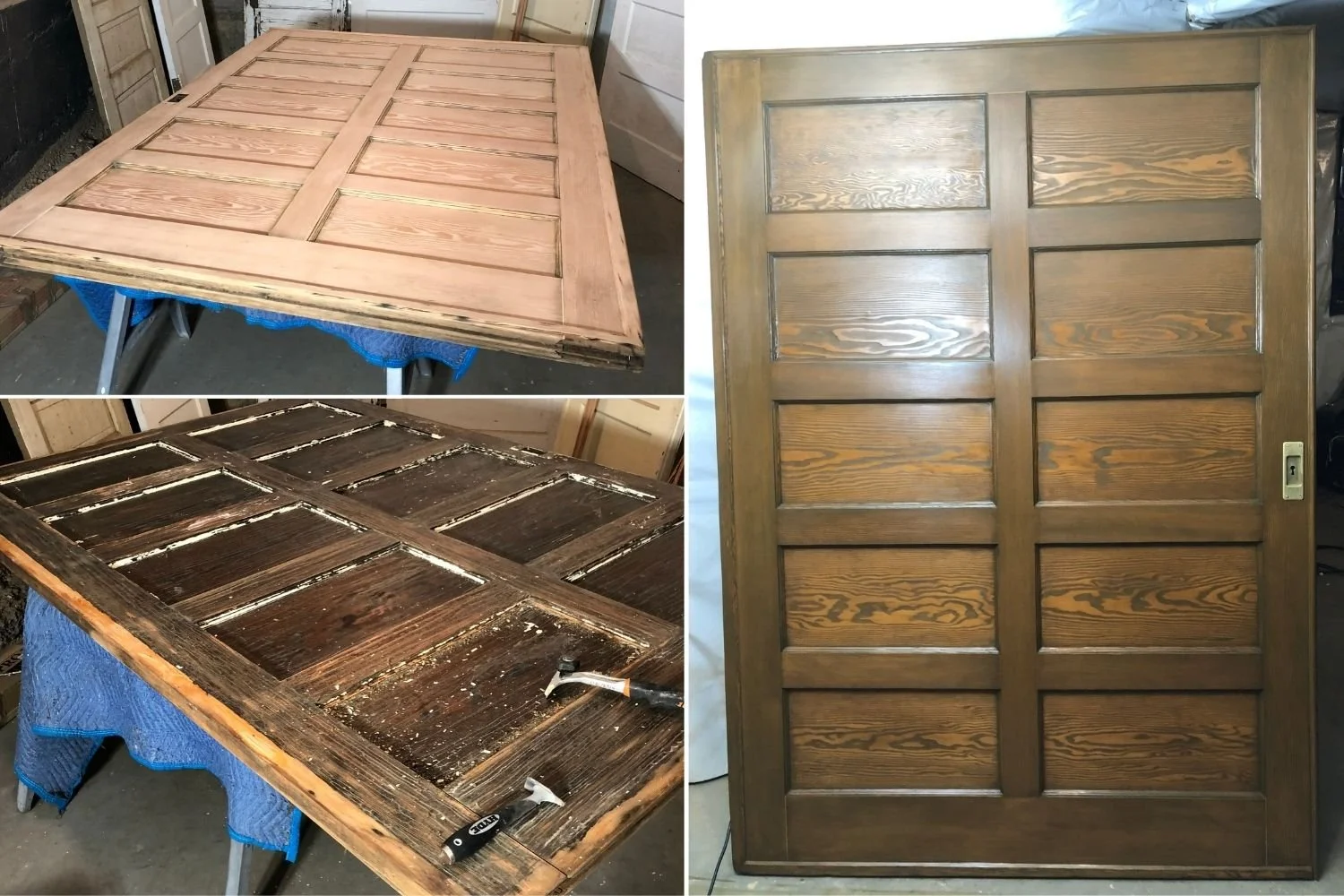
When you refinish a front door the right way, it’s a multi-day process. The door comes off the hinges and goes flat on sawhorses (working on it hung almost always leaves drips and uneven coverage). We strip the old finish — chemically, mechanically, or a mix of both depending on how many layers are on there — sand through progressively finer grits, condition the wood if it’s fir or pine, apply stain, and build up several coats of a marine-grade or spar-type exterior finish. The top and bottom edges get sealed too, which is a step that gets skipped more often than you’d believe and is the single biggest reason finishes fail early in Portland.
Done well, a refinish on an exterior door should last 6 to 10 years before it needs a maintenance recoat, and 15+ years before another full strip. Interior doors, obviously, last much longer between refinishes.
What you want to avoid: a contractor who says they can refinish your door “in place” in a day. That almost always means sanding over the old finish and rolling on new stain, which looks fine for about eight months and then starts peeling from the edges in.
When to Repair (Beyond Refinishing)
Repair work is what happens when the door has issues that go past the finish. In our experience, this is what actually describes most of the older Portland doors we see — they don’t just need a new coat of stain, they need someone to deal with a few small problems while the finish is off.
Common repairs we handle on older wood doors:
Localized rot at the bottom rail or jamb — often the lower 2 to 6 inches. Minor rot can be consolidated with epoxy and filled; more extensive rot gets a Dutchman repair (cutting out the damaged section and scarfing in new matching wood). Either is cheaper than a new door and preserves the original.
Loose or sagging joints — mortise-and-tenon joints on old doors can work loose over time. They can often be re-glued and clamped rather than replaced.
Sticking or binding — usually a hinge issue, a swollen door, or a jamb that’s shifted. Most can be fixed with a hinge adjustment, a plane pass, or new weatherstripping. Rarely does sticking mean the door is “done.”
Failed weatherstripping and thresholds — huge impact on energy efficiency, small cost to address.
Hardware issues — original mortise locks, knobs, and hinges can almost always be cleaned, tuned, or rebuilt. Replacing them with modern hardware often requires a bunch of filling and drilling you’d rather avoid.
Glass panel re-glazing — old putty around leaded or divided-lite glass panels cracks and falls out. New glazing compound seals it back up.
The sensible sequence is: refinish and repair in the same visit. You’ve already got the door off its hinges and stripped down — that’s the ideal moment to address the structural stuff. Doing them separately usually costs more and produces a worse result.
When to Replace Your Door
Replacement is the right call in a smaller set of situations, but when it’s the right call, it’s clearly the right call. Signs your door has crossed the line:
Rot goes through more than a third of a major component (a stile, rail, or panel), or is structural — you can feel the door flex
The door is warped or bowed enough that it no longer seals against the frame, and planing won’t fix it
It’s a modern hollow-core or cheap solid-core door that was never built to last
Energy loss is significant — you can feel drafts even when the door is closed and locked
The door has been damaged (fire, impact, water intrusion from a broken pipe) in a way that compromises its structural integrity
If you do replace, the single biggest piece of advice we give Portland homeowners: match the character of the home. A 1912 Craftsman doesn’t want a slab-style modern door. A post-war ranch doesn’t want a heavy six-panel traditional door. Doors are the most visible piece of trim on your house, and getting the style wrong pulls the whole curb appeal down — even if the new door is technically higher quality.
Custom and semi-custom wood doors from Oregon millwork shops aren’t as expensive as people assume, and the installation (including any required permits) is something a good contractor can walk you through.
Thinking about replacing but want a second opinion on whether refinishing or repair would work?
What It Costs in Portland
Ranges, not quotes — every door is different and we’d never give you a real number without seeing it. But for budgeting purposes:
Refinish only (exterior wood door) — roughly $600 to $1,500 depending on size, condition of the old finish, and number of coats. Interior doors are generally $300 to $700.
Refinish plus typical repairs (hinge adjustment, weatherstripping, minor joint repair, small rot fix) — roughly $900 to $2,200.
Refinish plus significant repair (Dutchman rot repair, re-glazing glass panels, hardware rebuild) — roughly $1,500 to $3,500.
Replacement with a quality solid-wood door — $2,500 to $6,000+ for door and installation, more for custom millwork or if the jamb also needs rebuilding.
Two notes on cost:
First, these are Portland-area ranges for licensed, insured contractors — not the cheapest number you’ll find on a handyman app. You want your door done by someone who’s actually restored a few dozen of them and knows what’s under the paint before they start stripping.
Second, almost every older Portland door has at least one surprise hiding under the finish. When you strip down to bare wood, you sometimes find a rot pocket or a hairline crack that wasn’t visible. A good contractor will walk you through the finding before doing the work and give you the option to address it or leave it. Nobody should be adding change orders without a conversation first.
What to Look for in a Portland Door Restoration Contractor
A few things worth checking before you hire anyone to work on your door:
Oregon CCB license — Oregon requires licensed general contractors to be registered with the CCB. You can look up any license at oregon.gov/ccb. Portlandia’s CCB number is #219486.
Liability insurance — ask for a certificate. Any legitimate contractor will send one without hesitation.
Actual door work in their portfolio — not generalist handyman work, not just paint. Ask to see before-and-after photos of wood door restoration projects in Portland specifically. Ours are here.
A straight answer on permits — some door replacements (especially when the jamb is modified or the opening is resized) require a permit. A good contractor knows when one is needed, pulls it, and includes it in the estimate.
Reviews from homeowners in older Portland neighborhoods — the closer to your situation, the better the signal. A contractor who’s worked on a 1915 Craftsman in SE Portland knows what to expect in your 1918 in NE Portland.
Veteran-owned, locally owned, and physically based in Portland are all reasonable filters too — you want someone who’s still going to be around in ten years when it’s time for the next maintenance recoat.
Common Questions from Portland Homeowners
Can I refinish my door myself?
Yes, but set realistic expectations. DIY refinishing usually produces a result that looks good for a couple of years and then shows its age. The difference is typically in surface prep — how completely the old finish comes off, how well the wood is sanded, and how the edges get sealed. If you’ve got the time and patience, it’s a reasonable weekend project. If you want it to last a decade, hire it out.
Will stripping damage the door?
Done right, no — stripping is a normal part of the door’s life cycle. Done carelessly (aggressive sanders, hot guns held too long, harsh chemicals left on too long), yes, it can scorch wood, feather out sharp edges, or lift veneer. This is why the tools and experience matter.
How often should I refinish my front door?
In Portland, plan on a light maintenance coat every 3 to 5 years and a full strip-and-refinish every 10 to 15 years. South- and west-facing doors need it more often than north- and east-facing doors — sun is what kills finishes here, not rain.
Is my door historic or protected?
If your home is in a designated historic district or on the National Register, there are rules about what you can change on visible exterior elements — including the front door. The city has a review process, and your contractor should know how to work within it. Most of our Portland clients are not in protected districts, but it’s worth a quick check before doing anything dramatic.
What about interior doors — pocket doors, French doors, bedroom doors?
All of the same logic applies, just without the weather exposure. Original interior doors — especially five-panel fir doors and old pocket doors with operating hardware — are almost always worth restoring.
The Short Version
Most older Portland wood doors have a lot more life left in them than people assume. Refinishing buys you another 10 to 15 years. Refinishing plus targeted repairs can keep an original door in service for another 30 or 40 years — longer than most new doors would last. Replacement is sometimes the right answer, but it shouldn’t be the first answer.
If you’re staring at your front door trying to figure out where to start, the fastest path forward is usually just to have someone look at it. We’d rather give you an honest “this needs a refinish, not a replacement” for free than sell you a job you don’t need.
Ready for a real answer on your door?
Request your free estimate below — we’ll come take a look and walk through your options. No pressure, no upsell.