
Signs Your Deck Needs Work, What It Costs, and When to Replace Instead
If you live in Portland and you’ve got a deck, you already know the deal. Six months of rain, three months of intense summer sun, and then back into the wet. Even a well-built deck starts showing its age after 10 or 15 years — loose boards, gray-weathered wood, a railing that has more give than it used to.
The good news is that most Portland decks we look at don’t need to be torn down and rebuilt. They need some boards replaced, some hardware tightened, maybe a post or two dealt with, and a good refinish. That kind of deck repair typically runs a fraction of a full rebuild and adds another decade to the deck’s life.
The tricky part is knowing which side of the line your deck is on. This guide walks through the signs to look for, what repair actually involves, what it costs in the Portland area, and the point where rebuilding makes more sense than patching.
Why Portland Weather Is Hard on Decks
Decks in Portland deal with a specific kind of abuse. It’s not the freeze-thaw destruction you get in New England or the punishing UV of Arizona — it’s the constant wet-dry cycle. Nine months of rain keeps the wood saturated; three months of dry heat bakes it back out. Every cycle opens up hairline cracks, loosens fasteners a little, and gives water another path into the end grain.
On top of that, moss and algae love our shaded, damp yards. A north-facing deck in SE Portland that doesn’t get much direct sun can go green in a single wet season. The moss itself isn’t the problem — it’s the fact that it holds moisture against the wood and keeps the surface from ever fully drying. That’s what kills deck boards from the top down.
Older decks built before the mid-2000s often have another issue: the fasteners used then weren’t rated for the newer pressure-treated lumber chemistries. Plain steel nails and screws in contact with modern pressure-treated wood corrode fast. If your deck is 20+ years old and the screws look rusty or the boards feel loose even though the wood is fine, that’s the cause.
Signs Your Deck Needs Attention
Before you call anyone, spend 10 minutes walking your deck with a screwdriver and a flashlight. Here’s what to check and what it usually points to:
Soft or spongy spots in the deck boards. Press a screwdriver into any suspect area, especially near the ends of boards or where water tends to pool. If it sinks in easily, that board has rot. One or two bad boards is a repair; a whole section is a bigger conversation.
Railing that wobbles or feels loose. Railings are the single most common deck code issue in Portland, and a wobbly rail is genuinely dangerous — more people get hurt from failed railings than failed deck structures. Most wobbly railings can be re-secured, but if the posts themselves are rotted at the base, you’re looking at post replacement.
Rust stains around screws and nails. Dark streaks bleeding out from fasteners usually mean the fasteners are corroding. In older decks with plain-steel hardware, this often means re-fastening with modern coated or stainless screws.
Rot at the base of posts. Posts that sit directly on concrete or, worse, in the ground, wick moisture and rot from the bottom. Check where posts meet the footing. If you can push a screwdriver into the wood near the base, that post is compromised.
Pulling away from the house (ledger board issues). The ledger is the board that attaches the deck to your house, and ledger failures are the most dangerous structural problem a deck can have. If there’s any visible gap between the deck and the house, cracking along the ledger line, or evidence of water damage to the siding behind the deck, stop using the deck and get a contractor out. This isn’t a wait-and-see situation.
Surface gray, splintering, or mossy. Aesthetic problems, usually. Gray weathering is cosmetic — a proper clean, sand, and stain will restore most decks that look rough on top but are solid underneath.
Deck boards cupping or crowning. If boards are curving up at the edges (cupping) or peaking in the middle (crowning), that’s usually a drying issue — sometimes solvable with refastening, sometimes the board needs replacing.
Deck Repair vs. Rebuild: The Quick Framework
Once you’ve done the walkthrough, you’ll usually have a sense of which category your deck falls into:
| What you're seeing | What it usually means |
|---|---|
| A handful of cracked or splintered boards, loose fasteners, railing that wobbles | Repair |
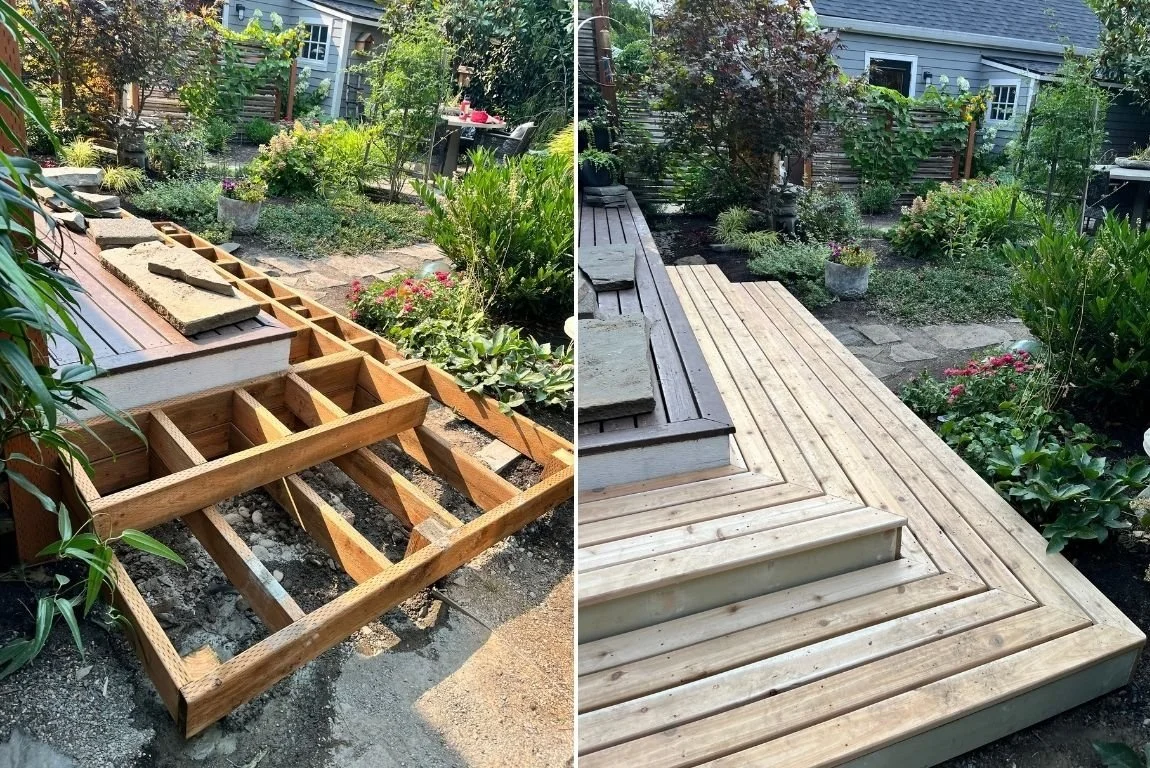
| Surface boards are rotting but the joists and posts underneath are solid | Resurface |
| Soft, spongy joists; rotted posts; deck pulling away from the house; failed ledger board | Rebuild |
In our experience, probably 70% of Portland decks we get called to look at are in the first two categories — they need real repair work, not a rebuild. Full tear-downs are the less-common call.
Not sure where your deck falls? A quick in-person look usually settles it in about 20 minutes.
When Deck Repair Is the Right Call
Deck repair makes sense when the bones of the deck — the joists, the posts, the ledger board — are still solid. Surface-level issues are almost always repair territory.
Common repairs we handle on Portland decks:
Replacing rotted or cracked deck boards with new boards that match (or close-enough to) the existing.
Re-fastening the entire deck with modern coated or stainless screws — often the single biggest difference-maker on older decks.
Tightening or replacing railing connections, adding proper post-to-deck hardware if it’s missing.
Post base repairs — sometimes a post can be cut off above the rotted section and re-seated on a proper post base, rather than replaced entirely.
Joist sistering — if a joist has localized rot, we can often attach a new joist alongside it instead of replacing the whole thing.
Adding or replacing flashing at the ledger to stop water getting behind the deck and into the house.
Pressure washing, sanding, and refinishing — the right sequence matters here. Pressure washed too aggressively, wood fibers get destroyed and the next stain won’t soak in evenly.
A thorough repair-plus-refinish on a mid-sized Portland deck will usually last another 8 to 12 years before it needs serious attention again, assuming you’re doing light maintenance (clean and recoat stain every 2 to 3 years) in between.
When It’s Time to Rebuild
Some decks have crossed the line where repair doesn’t make economic sense anymore. The clearest signs:
The joists or beams underneath are rotted or compromised. Once the structure is going, patching is usually throwing good money after bad.
The ledger board is failing or was never properly installed. We see a lot of older Portland decks with ledgers bolted directly to siding without flashing — a slow-motion failure that often takes the house framing with it.
Deck posts are rotted at multiple points, and footings don’t meet current code. If we’re replacing posts and re-doing footings, we’re close to a rebuild anyway.
The deck doesn’t meet current Oregon code on railing height, baluster spacing, or stair safety — and you’re planning to sell in the next few years.
You want to significantly change the footprint, layout, or height — which almost always requires a permit and new structure.
Widespread fastener corrosion is combined with board rot — at that point, you’re replacing enough material that a rebuild produces a better result for similar money.
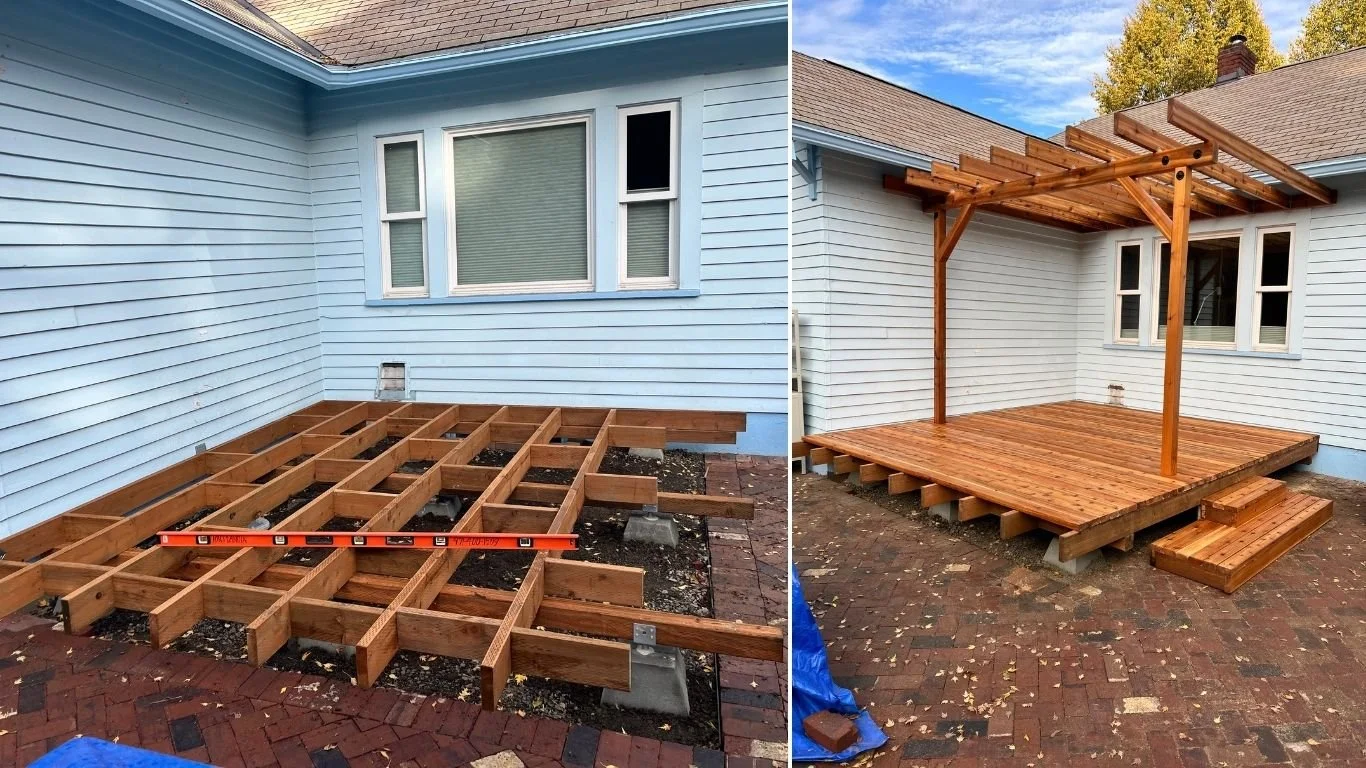
A rebuild isn’t always bad news. A new deck built with modern materials (composite decking, hidden fastener systems, hot-dipped or stainless hardware, proper flashing) requires dramatically less maintenance than the pressure-treated deck it replaces. If your deck is 25+ years old, there’s a good argument that you’ll spend less over the next 20 years by rebuilding once than by doing a series of increasingly expensive repairs.
Thinking rebuild but want a second opinion? We’ll tell you honestly if repair would work instead.
What Deck Repair Costs in Portland
Ranges, not quotes — every deck is different. But for budgeting purposes, here’s roughly what deck repair costs in the Portland area:
Minor repairs (a handful of replaced boards, re-securing railings, tightening hardware) — roughly $500 to $1,500.
Mid-level repairs (replacing 10–20 boards, re-fastening the whole deck, minor post or joist work, clean-and-stain) — roughly $1,800 to $4,500.
Deck resurfacing (replacing all deck boards and railings, keeping the substructure) — roughly $5,000 to $12,000 for most residential decks, more for larger or multi-level decks.
Full rebuild with pressure-treated materials — roughly $35–$60 per square foot for a straightforward ground-level deck. A 200-square-foot deck generally lands in the $7,000–$12,000 range.
Full rebuild with composite decking (Trex, TimberTech, etc.) — roughly $55–$90 per square foot, so closer to $11,000–$18,000 for the same 200-square-foot deck. More material cost upfront, much less maintenance over the deck’s life.
Two cost notes worth flagging:
First, these ranges assume a licensed, insured contractor — not the cheapest quote you’ll find on Thumbtack. Deck work is one of the areas where cheap labor and cheap materials fail fast. A sub-$2,000 “deck repair” that skips re-fastening, flashing, or proper post bases will be back on your to-do list inside three years.
Second, older Portland decks almost always have at least one surprise hiding under the surface. When we pull boards to replace them, we sometimes find hidden rot in joists, a ledger that was never flashed, or posts that have been quietly rotting for a decade. A good contractor will tell you what they find, walk you through options, and never add change orders without a conversation first.
What to Look for in a Portland Deck Contractor
Deck work is one of the most common places Portland homeowners get burned by under-qualified contractors. A few things to check:
Oregon CCB license. Oregon requires licensed general contractors to be registered with the Construction Contractors Board. Look up any license at oregon.gov/ccb. Portlandia’s CCB is #219486.
Liability insurance. Ask for a certificate. Any real contractor will send one without hesitation.
Permits, when required. Full rebuilds and significant structural work in Portland typically require a permit. A good contractor knows when one’s needed, pulls it, and includes it in the estimate — they don’t try to talk you out of permitting because “nobody checks.”
A realistic estimate timeline. Proper deck repair takes time to estimate correctly — the contractor needs to look under the deck, check the ledger, probe suspect areas. A two-minute drive-by estimate usually means they’re not actually looking at what matters.
Reviews from homeowners with similar decks. Somebody who’s only built new decks for new construction isn’t the right pick for diagnosing and repairing a 1995 pressure-treated deck on an older Portland home.
Veteran-owned, locally based, and willing to give honest answers on repair-vs-replace are all reasonable filters. You want a contractor who’s going to still be around in a few years if something needs follow-up.
Common Questions from Portland Homeowners
How long should a deck last in Portland?
A properly built pressure-treated deck with good hardware and regular maintenance should last 20–25 years. Composite decks often hit 30+. Where decks die early in Portland is when they’re built without proper flashing, without post bases, or with outdated fasteners — any of those can cut a deck’s life in half.
How often should I stain or seal my deck?
For a stained wood deck, plan on a maintenance coat every 2 to 3 years. South- and west-facing decks burn through stain faster than north- and east-facing. A fully shaded deck might stretch to 4 years but will need more aggressive mold/moss cleaning. Sealer-only products need refreshing more often — typically annually.
Can I repair a deck myself?
Replacing a few boards or tightening railings is a reasonable DIY project if you’re comfortable with basic carpentry. Things we’d recommend leaving to a pro: any structural work (joists, posts, ledger), anything involving flashing and your home’s weather barrier, and anything that requires a permit. The cost of getting structural deck work wrong is meaningfully higher than the cost of hiring it out.
Is composite decking worth the extra cost?
For most Portland homeowners who plan to stay in the house 10+ years, yes. You pay more upfront, but you skip the stain-every-3-years treadmill and the composite holds up better to our constant wet-dry cycle. If you’re planning to sell within a couple of years, the math is less clear.
Do I need a permit for deck repair?
Usually no for straight repair — swapping boards, re-fastening, refinishing, replacing railings to match. Permits are typically required when you’re changing the structure (new posts, new footings, modified framing) or the footprint, or when the deck is more than 30 inches above grade and rebuilt in a way that reclassifies it. Your contractor should tell you upfront whether a permit is needed and handle pulling it.
What’s the difference between deck repair and deck resurfacing?
Repair is targeted — you’re fixing specific problems (a few boards, the railing, some rot). Resurfacing means replacing all the deck boards and usually the railings while keeping the existing substructure. Resurfacing makes sense when the structure is solid but the surface is widely weathered or rotted.
The Short Version
Most Portland decks have more life left in them than homeowners assume. The surface takes the visible abuse — gray wood, cracked boards, loose railings — but the structure underneath is usually still doing its job. Good repair work can add another decade to a tired-looking deck, and honest cost for solid work is generally less scary than people expect.
If you’re standing on your deck right now wondering whether to fix it or rip it out, the fastest way to find out is to have someone look at it. We’d rather give you an honest “you’ve got 5 more years out of this one” than sell you a rebuild you don’t need.
Ready to find out what your deck actually needs?
Request your free estimate below — we’ll come out, take a look, and walk you through your options. No pressure, no upsell.